

5 Signs Your Business Needs an ERP System
June 23, 2025
As technology advances, businesses are spending more time managing tools than focusing on growth. Data silos are preventing organizations from making informed business decisions. At this juncture, cloud ERP software and enterprise resource planning solutions have emerged as a game-changer. They integrate core functions into a single platform, supporting business process automation, improving visibility, and boosting collaboration. ERP software for companies and small businesses is a winning strategy that drives growth, delivers long-term ROI, and enhances efficiency.
However, every organization has unique business needs, and some clear warning signs show the need for ERP implementation. This blog details the top five warning signs that indicate when your business needs an ERP system. Furthermore, we’ll explain how the right solution can improve your business operations.
What is an ERP system?
An Enterprise Resource Planning (ERP) system is a comprehensive business management software platform that enables companies to manage and automate their business processes. Modern ERP systems are often cloud-based ERP solutions, making them mobile-ready and accessible from anywhere. They integrate finance, logistics, HR, inventory, and customer relations into a single core system. Businesses lean towards ERP implementation to eliminate fragmented systems and improve their digital transformation strategy.
Moreover, AI-powered ERP solutions build predictive analytical models, which help companies automate processes. For improving operational efficiency, increasing ROI, and supporting scalability, ERP software for businesses is a cost-effective solution.
Read also: Enterprise Application Integration
5 Key Signs Your Business Needs an ERP System
We live in a hyper-digital world, where businesses often struggle to resolve customer pain points effectively. Every business is unique and requires different cloud ERP solutions. Let’s explore the top five signals that indicate the need ERP system:
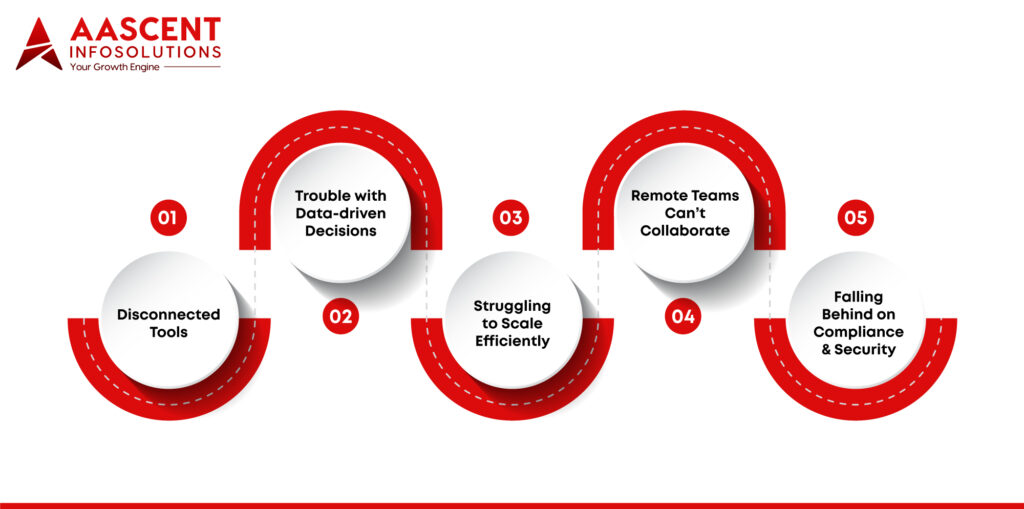
1. Too Many Disconnected Tools
If your teams use isolated tools for accounting, inventory, CRM, and project management, it creates data silos in ERP. These silos lead to inconsistent data, manual errors, and inefficiencies. As of 2025, productivity in top companies has dropped by up to 20% due to tool switching and data fragmentation.
Companies are now using cloud-based ERP software for automation and efficiency to consolidate different outdated separations into one platform. ERP data integration is another effective approach that minimizes redundant work, enhances visibility, and simplifies workflow across different departments.
2. Trouble with Data-driven Decisions
Are you still using outdated spreadsheets to make business decisions? This often leads to inaccurate reports, poor KPI tracking, and slow decision-making—all of which limit business growth.
Past Analysis: Initially, AI-powered ERP systems deeply analyze your historical data stored in the ERP. It then understands performance trends, identifies recurring issues, and evaluates the past strategies that worked well. Companies can utilize this precious information to make effective, data-driven ERP decisions.
Effective Forecasting: AI bases its predictions on historical and existing data. This method helps businesses make informed decisions while reducing threats.
Example: Recently, a Bangalore-based SaaS company invested in AI-based ERP solutions. This latest method has enhanced their forecasting by 40% and cut down monthly reporting time by 70%.
3. Struggling to Scale Efficiently
As technology advances, customer bases often grow rapidly. ERP for scalability and digital transformation is the right choice if you want to scale resources efficiently and meet evolving market needs. The customer base often grows with increasing technological advancements. ERP for digital transformation is the right choice if you’re looking to scale your resources effectively with the growing market needs. It is essential for streamlining and automating daily operations. Choose cloud-based enterprise solutions when you want to expand your business globally while adding new features.
Real-World Stat: Panorama Consulting recently shared a report about ERP implementation. It clearly states that nearly 81% of companies are using custom ERP software to improve their operational efficiency.
4. Remote Teams Can’t Collaborate
Seamless communication and data access have become the backbone of distributed workforces. If your remote teams use outdated systems, it limits data access, reduces productivity, and affects business growth.
Modern businesses use ERP for remote collaboration to bridge gaps with cloud access, shared dashboards, and centralized data. Hybrid workforce ERP solutions also support unified operations, regardless of location or device.
For instance, imagine your developer team is from Chennai and the sales team is from Hyderabad. Cloud ERP platforms help them connect everyone in real time.
5. Falling Behind on Compliance and Security
Compliance is an essential data security approach in our hyper-connected world. Is your ERP system or enterprise application development system struggling to meet standard industry regulations or lacking regular audit trails? Then, it’s a clear sign showing that your current systems are at risk.
Modern ERP systems offer built-in compliance management in ERP software, which prevents companies from falling behind in security and compliance. Furthermore, custom ERP solutions have secure storage systems, user access controls, and encrypted communication channels. Startups use ERP software for small businesses, which makes them ready for audits and complaints.
Read also: enterprise application trends
Top Benefits of Implementing an ERP System
From simplifying complicated processes to improving security measures, the benefits of ERP solutions for businesses are hard to ignore. ERP for business growth can transform the way companies handle real-time data analytics securely. Here’s how enterprise resource planning systems lay the foundation for sustainable growth:
Streamlined Processes: AI in ERP software can handle complex tasks and standardize processes, which accelerates turnaround.
Unified Data: ERP for automation and efficiency centralizes business databases. This technique boosts uniformity and precision throughout the organization.
Real-Time Reporting: With ERP implementation, companies get access to gather real-time data insights.
Cost-Effective: Data integration with ERP can help cut unexpected funding, manual errors, and inefficiencies.
Scalability: Enterprise application development is scalable. It is uniquely created to manage increasing requirements with a flexible infrastructure.
Remote Access: Use ERP for remote teams to empower cloud-native interfaces.
Enhanced Security: Implementing role-based permissions and advanced threat detection is a key feature of ERP implementation.
AI-driven Insights: Contemporary companies employ ERP for business expansion to anticipate dominant trends, estimate demand, and strategize for normal requirements.
Customizability: Tailored ERP solutions address unique industry-specific needs.
Read also: Enterprise Solutions for Healthcare
Conclusion
Outdated or split systems usually keep your company from attaining long-term success. Investing in ERP software for businesses is a strategic move if you have disconnected tools, a lack of data insights, poor collaboration, and compliance risks. Whether you’re a startup or scaling enterprise, ERP for business growth is a technical upgrade that aligns perfectly with your unique goals and needs. Are you looking to future-proof your growth with enterprise software solutions? We at Aascent InfoSolutions specialize in ERP implementations that help unlock your true business potential. Contact us today to learn how modern ERP systems reduce inefficiencies while maintaining a competitive edge.


