

Common Mistakes to Avoid When Adopting Enterprise Mobility
August 18, 2025
Nearly 87% of companies have adopted enterprise mobile solutions to boost productivity and agility. Yet, almost half of them still struggle with failed implementations. Remember, adopting enterprise mobility isn’t as simple as rolling out a few mobile apps. The common enterprise mobility adoption mistakes are security gaps and an inconsistent user experience. However, each of these pitfalls can be effectively addressed with the right solutions.
In this blog, we’ll break down the top 7 enterprise mobility challenges that hurt ROI. Plus, we’ll share some practical tips to navigate them early.
Top Mistakes to Avoid When Adopting Enterprise Mobility
With enterprise mobility services, employees stay connected with up-to-date data. But if they fail to work with effective planning, it can create a costly headache. However, identifying the common mistakes in enterprise mobility management (EMM) helps you save time and money. Now, let’s see the top 7 enterprise mobility mistakes with the practical strategies to navigate them.
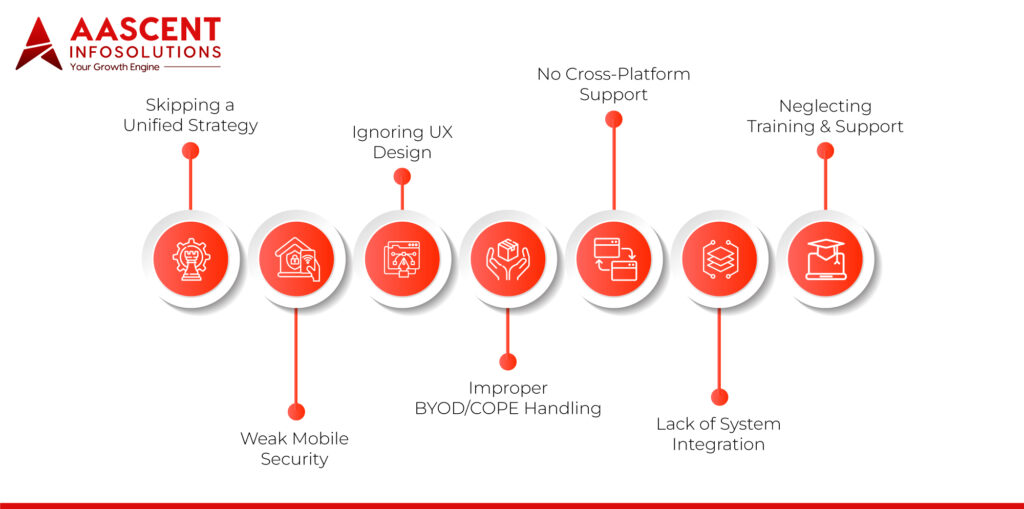
1. Skipping a Unified Strategy
A siloed approach in enterprise mobility strategy often creates redundant systems that hinder growth. It increases development cost and delivers inconsistent user experiences.
Proven Solutions
- Create a tailored, scalable mobile strategy.
- Define all the KPI frameworks. This includes adoption rates, session lengths, and transaction values.
- Include stakeholders from IT, security, HR, and other units in your business strategies.
Follow a unified plan to avoid duplicative issues. Plus, create your mobility goals by keeping business objectives in mind.
Read also: How to Integrate New Enterprise Solutions with Existing Systems
2. Weak Mobile Security
Mobile devices are now among the easiest targets for cyberattacks. If you fail to take care of enterprise data security, it will open the doors to hackers. You might risk data loss and face compliance issues.
Common weaknesses include:
- Improper authentication (SMS-based OTPs).
- Lack of mobile threat detection.
- No secure data containers for sensitive information.
Recommended solutions:
- Deploy mobile device management (MDM) and mobile application management (MAM) platforms.
- Use multi-factor authentication.
- Create a biometric login.
- Implement secure containerization.
Want to avoid major enterprise mobility mistakes? Then stick to the outlined plans. It will protect your business from costly setbacks.
3. Ignoring UX Design
According to recent reports, 71% of IT leaders are searching for better ways to enhance their user experience. Yet most of them neglect enterprise UX design best practices during enterprise mobility implementation, which is a huge mistake. Poor design often reduces productivity, frustrates users, and increases bounce rates.
Where UX often falters:
- Cluttered or slow interfaces.
- Inconsistent design patterns across platforms.
- Lack of accessibility features.
UX best practices:
- Collect user feedback and conduct usability tests.
- Follow platform-specific design guidelines.
- Monitor and fine-tune interactions.
Adopt professional enterprise mobile app development services to design high-performance solutions that engage users effectively.
4. Improper BYOD/COPE Handling
BYOD policy best practices and COPE mobility solutions offer high flexibility. But managing them improperly invites complexity.
- BYOD without guidelines leaves corporate data at risk as they are managed from different devices.
- COPE with limited configuration often creates trust issues amongst employees due to invasive oversight.
Optimal policy models:
- Apply containerisation and split billing.
- Limit corporate data to secure sandboxed apps.
- Communicated with staff about scope and access permissions.
If handled correctly, your approach to BYOD/COPE will support secure enterprise mobility management. It helps you improve device security and employee satisfaction.
Read also: The Role of AI in Modern Enterprise Solutions
5. No Cross-Platform Support
In today’s competitive ecosystem, enterprises operate across iOS, Android, Windows, and many other platforms. Yet some IT teams release apps that can work only on one platform due to a rush and to cut costs. But what’s the result? User fragmentation and strained support resources.
Actionable Steps:
- Utilize cross-platform enterprise apps frameworks.
- Design responsive apps.
- Maintain consistent testing across devices.
For effective enterprise mobility implementation, keep cross-platform working in mind. This approach lets you build apps that reach a wider audience with fewer codebases.
6. Lack of System Integration
Are your mobile apps still relying on outdated APIs? Or do they struggle to integrate with backend systems? Then it will create data silos, sync issues, and redundant apps.
For instance, if you’re building a mobile sales app that fails to sync with CRM or ERP. Then it will operate without real-time data.
Integration Strategies:
- Use scalable integration platforms–MuleSoft or Dell Boomi.
- Adopt API-first enterprise mobility architecture.
- Implement event-driven synchronization.
Seamless integration avoids major enterprise mobility adoption mistakes. It delivers consistent data throughout the business.
7. Neglecting Training and Support
Even with great apps and strong security systems, employees may still struggle without proper onboarding. Nearly 63% of failed tech projects were due to poor training and change management.
Common deficiencies:
- No end-user learning paths.
- Slow or outsourced support.
- Missing knowledge base or in-app help.
Solutions:
- Develop role-based training supplemented with interactive videos.
- Implement dedicated support channels.
- Monitor usage metrics.
Strong training and support help you tackle the common enterprise mobility challenges. It allows you to create scalable apps.
Read also: Enterprise Application Development Trends 2025
Conclusion
Adopting enterprise mobility solutions is a winning business strategy that drives digital transformation. But without proper implementation, it can create more silos. Follow effective solutions that help you navigate these enterprise mobility adoption challenges. It decreases security threats and improves ROI.
Start with a well-defined enterprise mobility strategy, and focus on enhancing security and user experience. It will allow you to create a mobile-first workplace. By avoiding these enterprise mobility mistakes, you can establish a solid foundation that fuels long-term success. Do you want to circumvent such enterprise mobility issues? Then partner with Aascent InfoSolutions. Our expert team develops tailored enterprise mobility management solutions that ensure secure and scalable implementation. Contact us today to get started!


