

How AI and Cloud Are Revolutionizing Software Testing
July 18, 2025
Over 63% of organizations are now using AI in software testing. Meanwhile, 70% are adopting cloud-based testing platforms. Emerging businesses are accepting this transformation to address the increasing demand for a cost-effective, scalable, high-performance solution with faster testing cycles. Conventional approaches often create silos, making it difficult to keep up with today’s fast-changing market trends. AI and cloud-based tools are no longer just buzzwords, assisting businesses in realizing tangible outcomes.
AI-driven test automation always focuses on reducing the need for human intervention to reduce issues. On the other hand, cloud-based systems are essential to navigate infrastructure challenges. In this blog, let’s see how AI strategies like self-healing tests and predictive models are transforming the way software is tested. Plus, we’ll provide valuable insights about how cloud-based testing redefines the infrastructure at scale, boosting ROI.
The Power of AI in Enhancing Software Testing
AI-based test automation unites artificial intelligence (AI) and machine learning (ML) algorithms to enhance software performance. AI-powered QA tools learn from past test runs and provide valuable insights. From software testing automation to accelerating the process, the benefits of AI in testing are undeniable. It minimizes the time and energy expended in manual testing.
Key Advantages:
Faster Testing Cycles: They run several test cases in parallel, which accelerates the testing cycles.
Improved Accuracy: AI-based software testing tools scale their algorithms with growing business needs. It helps them reduce the number of false positive test cases.
Increased Test Coverage: AI tools automate the generation of test cases by analyzing documents, user behavior, and historical errors.
Nearly 40% of organizations are now using AI-powered QA tools. This approach has accelerated their release cycles by up to 30%.
The Role of Cloud-Based Test Automation
As of 2025, CI/CD pipelines are getting more complex. Cloud-based software testing is an effective strategy to save time and resources required for computing needs. With AI cloud testing, teams can run several test cases across environments without any physical setup.
Key Benefits:
Scalability: Cloud-based AI test infrastructure allows users to scale resources as their business grows.
Increases Team Collaboration: With AI-based cloud infrastructure, QA and software teams can collaborate more efficiently. It automates feedback loops, helping companies reduce the time-to-market.
Cost Reduction: If you’re using cloud testing tools, then there is no need to buy and set up new servers. This approach will gradually reduce the maintenance and labor costs.
BrowserStack and LambdaTest are the top services, supporting AI-driven test automation. They use live debugging and versioning features to operate at scale.
How AI and Cloud Improve Test Automation Efficiency
Have you ever wondered how both AI and cloud enhance testing? It promotes collaboration, helping teams innovate products that are highly flexible and scalable. Let’s see the step-by-step integration that shows the pivotal role of AI and cloud in software testing.
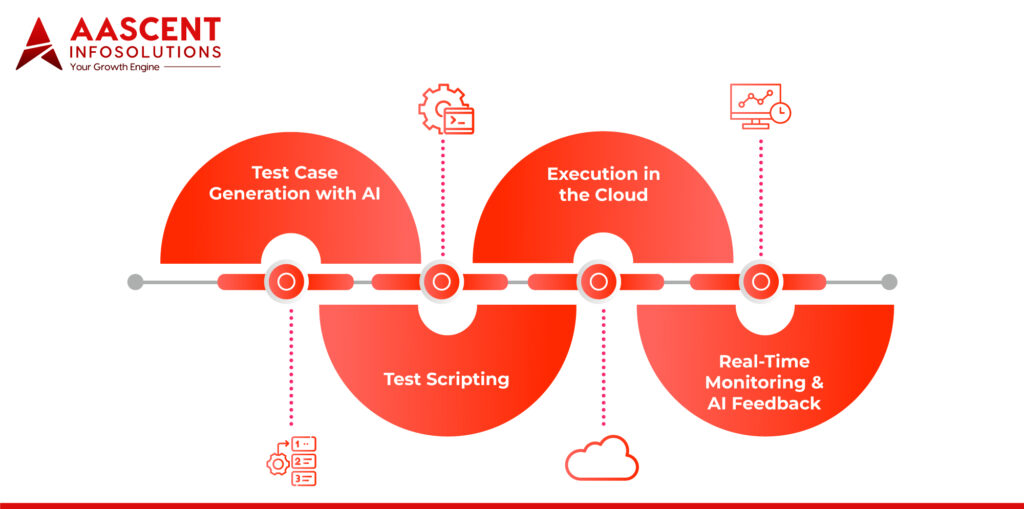
Test Case Generation with AI: Auto-generate test cases using past data, change logs, and code coverage reports.
Test Scripting: Natural language processing is an effective technique that simplifies the scripting process. Testers use them to write test cases in plain English. Later, it was converted into automated scripts.
Execution in the Cloud: These AI-generated scripts are then moved to a cloud-based test environment. Here, the test cases run across real devices and browsers, which ensures their quality and efficiency.
Real-Time Monitoring & AI Feedback: Finally, AI analyzes the results, gathers valuable feedback, and learn from false positives. This approach helps generate self-healing test scripts that adapt to changes automatically.
In general, AI-driven automation and scalable cloud infrastructure are highly essential. They make testing more efficient, identify issues earlier, and speed up deployment.
Use Cases: Where AI and Cloud Make a Difference
From banking and finance to e-commerce and SaaS, AI and Cloud-based strategies are redefining software testing. Take a glance at these real-world use cases that state the growing need for test automation in a cloud environment.
- E-commerce Platforms: Shopify and Flipkart platforms were using AI-driven test automation. This helps them simulate user behavior, test checkouts and payment flows in real-time.
- Banking & FinTech: These sectors rely on cloud-based platforms to ensure secure, compliant transactions. Whereas, their AI-powered testing tools enhance coverage of critical modules.
- SaaS Companies: Top-tier software companies embrace cloud-based AI test infrastructure to automate testing and CI/CD pipelines. This helped them achieve a 90% increase in test coverage while drastically lowering their release cycle times.
How to Overcome Challenges in AI and Cloud Testing
Although AI and Cloud-based automation are advantageous in multiple ways, their deployment is likely to introduce silos. Let’s talk about the typical challenges and the winning strategies for overcoming them.
1. High Initial Setup Complexity
Incorporating AI algorithms into established QA pipelines is likely to be a resource-intensive and laborious process. Plus, when we migrate user data into cloud environments, it requires high resource usage.
Solution: Start with small and simple solutions. Make use of AI-based testing tools that have a limited test scope, like Testim or Functionize. For cloud adoption, prefer modular migration strategies that support hybrid models.
2. Skill Gaps in Test Automation and Cloud-based Tools
Most of the QA teams often have less knowledge about machine learning models, NLP algorithms, and simple cloud platforms.
Solution: Upskill your teams by conducting AI-focused QA workshops and giving them hands-on training for using cloud platforms.
3. False Positives in AI-powered Test Cases
AI models can sometimes spot unnecessary issues. This often leads to flaky tests or mistrust in automation outcomes.
Solution: Make use of predictive analytical models to fine-tune your testing patterns. Implement self-healing tests that auto-correct broken scripts without human intervention.
4. Security & Compliance in Cloud Testing
While migrating sensitive testing data to the cloud environment, it can bring compliance issues. This might affect access control and data privacy.
Solution: Use a cloud-based AI test infrastructure that’s ISO and GDPR compliant. Set up role-based control systems and carry out end-to-end encryption to improve security.
Conclusion
In 2025, AI in software testing and cloud-based test automation will revolutionize the future of software testing. They go beyond innovation, bringing effective strategies that help companies embrace current trends on a scale. Test automation with AI and flexible cloud environments plays a key role in unlocking long-term success. They speed up the release cycles, improve test quality, and lay the way for achieving better customer satisfaction.
Want to future-proof your testing strategy? Then it’s time to collaborate with Aascent InfoSolutions. We apply AI-based test automation and cloud testing approaches to speed up QA cycles, enhance precision, and cut costs. Get in touch now to upgrade your business process with our high-grade software testing services.


