Best 7 Frameworks for Building AI Agents in 2025
September 19, 2025
Over 65% of enterprises are adopting or piloting advanced AI agents into their workflows. From streamlining intricate operations to handling customer requests and improving sales, AI agent services are everywhere right now. Agent AI frameworks reduce manual workloads, which minimizes human-made errors. In addition, they simplify complex agent orchestration and multi-AI agent development while reducing time-to-market.
Instead of juggling various people, tools, and processes, AI agent development services make tasks smoother, faster, and smarter. Startups are now embracing custom AI agent development to build cost-efficient, hassle-free applications from the ground up.
This blog offers an in-depth, practical view of the best AI agent frameworks in 2025. We’ll also provide an AI agent framework comparison table, which helps you choose the right one that matches your project goals.
What are AI Agent Frameworks?
AI agent frameworks are structured toolkits or platforms. They enable developers to build, deploy, and handle AI agents with ease. AI agent development frameworks often provide pre-built modules, APIs, and integrations. It is helpful for natural language processing, memory management, API integrations and multi-AI agent development. Modern AI agents have become the backbone of top-tier enterprises looking to innovate at a scale without reinventing the wheel.
The Importance of AI Agent Frameworks
AI agent development services form a cornerstone of AI progress, helping the field advance in multiple ways:
1. Rapid Development
Top AI agent frameworks come with ready-made components and proven methods. They drastically cut the time and effort needed to build sophisticated AI agents.
2. Standardization & Collaboration
The most popular AI agent frameworks bring a common approach to recurring challenges. It allows teams to work together and share knowledge.
3. Built-in Scalability
AI agent services support everything, from single-agent setups to complex multi-agent environments. It helps your system grow without starting over.
4. Greater Accessibility
AI agent development services have intricate technical features that allow developers and researchers to work with advanced AI techniques.
5. Enabling Innovation
AI automation frameworks are designed uniquely to handle heavy-lifting workflows. So, you can spend more time experimenting with new features, boosting innovation without boundaries.
Read also: The Role of AI in Modern Enterprise Solutions
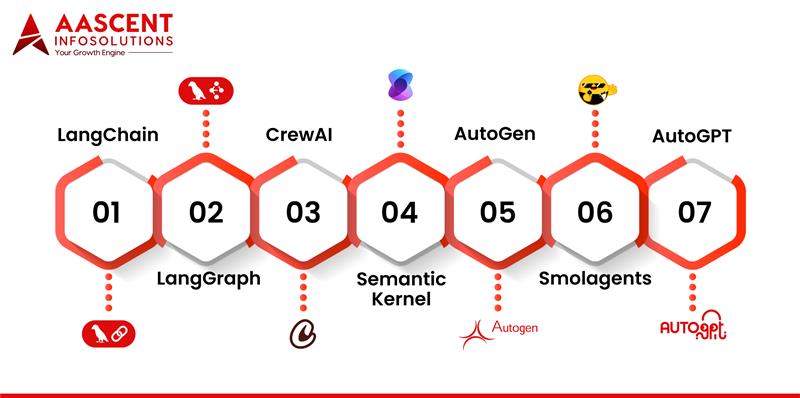
Top 7 AI Agent Frameworks You Need to Know in 2025
Curious about the best AI tools for 2025? These top AI agent frameworks will surprise you. They’re smarter, faster, and built to make AI development easier than ever.
1. LangChain
LangChain is one of the most popular AI agent frameworks, which is robust and flexible. This helps developers build applications using large language models (LLMs) more easily. It also provides the tools and building blocks needed to create advanced AI agents. These agents can handle complex reasoning, execute tasks, and interact with external data sources and APIs. Working with LLMs often means facing several challenges. These include maintaining context over long conversations, incorporating external information, and coordinating multi-step processes.
Features of LangChain
- Chain and agent abstractions for complex workflows
- Memory management and context handling
- Easy integration with multiple LLMs
2. LangGraph
LangGraph is another of the best AI agent frameworks in 2025, which is an extended version of LangChain. It helps developers build stateful, multi-actor applications with large language models (LLMs). This framework is perfect for building complex, interactive AI systems. It also supports planning, reflection, and coordinated multi-agent workflows.
Features of LangGraph
- Stateful interactions and workflows
- Multi-agent coordination and communication
- Seamless integration with LangChain’s components and tools
3. CrewAI
CrewAI is a framework for orchestrating role-based AI agents. It lets developers build a “crew” of agents, each with its own role and responsibility. Modern-day businesses are embracing this framework to work together on complex tasks. This makes it ideal for creating collaborative AI systems that solve multifaceted problems through coordinated efforts.
Features of CrewAI
- Role-based agent architecture
- Dynamic task planning and delegation
- Sophisticated inter-agent communication protocols
4. Semantic Kernel
Microsoft Semantic Kernel bridges traditional software development with AI. It makes it easy to integrate large language models (LLMs) into existing applications. Developers can add AI functions without rebuilding their codebases. The framework supports multiple programming languages for greater flexibility. Its orchestrators manage complex, multi-step AI tasks. This enables sophisticated AI-driven workflows inside existing apps.
Features of Semantic Kernel
- Seamless AI integration into applications
- Multi-language support
- Orchestrators for managing complex tasks
5. AutoGen
Microsoft AutoGen v0.4 is an open-source framework from Microsoft Research. It helps developers build advanced AI agents and multi-agent systems. The framework offers a flexible toolkit for creating task-focused AI applications. Its modular, extensible design lets developers build smart AI systems much faster.
Features of AutoGen
- Multi-agent conversation framework
- Customizable agent roles and behaviours
- Integration with external tools and services
6. Smolagents
Smolagents is an open-source framework for building intelligent, collaborative multi-agent systems. It gives developers a flexible toolkit to create AI agents. These agents can work independently or alongside human oversight. Its modular design makes it easy to develop adaptive AI systems.
Features of Smolagents
- Lightweight and modular multi-agent architecture
- Seamless integration with various language models and APIs
- Robust communication protocols for inter-agent dialogue
7. AutoGPT
AutoGPT is built on the powerful GPT-4 language model. It executes goal-oriented tasks through simple language input. It goes beyond basic reflex agents and offers advanced features. These features make it a valuable tool across many applications. It is designed to elevate decision-making and streamline complex processes.
Features of AutoGPT
- GPT-4 powered autonomous agent
- Multi-step goal decomposition for complex tasks
- Internet plus memory access for real-time information retrieval
Read also: How AI Automation Makes SaaS Development Faster and Smarter
Comparison of AI Agent Frameworks
Wondering which framework fits your needs? This AI agent framework comparison table makes it simple. See how each tool stacks up, compare features easily, and choose smarter for 2025.
| Framework | Key Focus | Strengths | Best For |
| LangChain | Building apps powered by large language models. | Smooth integration with APIs and data sources. Flexible design. | Creating versatile AI apps that need reasoning plus external data. |
| LangGraph | Coordinating multiple stateful AI actors. | Handles complex, connected workflows with ease. | Developing interactive systems with planning and reflection. |
| CrewAI | Organizing role-based AI teams. | Enables collaborative agents with distinct roles. Dynamic task sharing. | Running multi-expert or organizational AI scenarios. |
| Semantic Kernel | Adding AI to existing enterprise software. | Secure and compliant. Works with multiple programming languages. | Upgrading corporate apps with AI features without major rewrites. |
| AutoGen | Designing multi-agent conversational systems. | Modular, extensible, with strong context and error handling. | Automating advanced conversations or task-driven processes. |
| Smolagents | Lightweight collaborative AI systems. | Simple to customize. Efficient and modular | Quickly deploying adaptive multi-agent solutions. |
| AutoGPT | Fully autonomous AI agents. | Adapts with minimal supervision. | Automating content creation and research. |
This table acts as a quick reference to understand each framework’s core features. Analyze them deeply and choose the best framework based on your unique business needs. You can also combine frameworks to create a feature-rich application.
Read also: Top 10 AI Tools for Software Development
Conclusion
AI agent frameworks are transforming how businesses build intelligent systems. As of 2025, the top 7 AI agent frameworks are LangChain, LangGraph, CrewAI, Semantic Kernel, AutoGen, Smolagents, and AutoGPT. But each of the above AI agent development frameworks caters to different needs. From LangChain’s versatile LLM tools to AutoGPT’s autonomous workflows, each platform offers unique strengths. Modern enterprises embrace these frameworks to reduce human-made errors and speed up deployment.
How do we build and deploy AI agents?
At Aascent InfoSolutions, we follow a structured approach to building innovative AI agents. Our approach ensures every solution is practical, secure, and personalized. Here’s how we do it:
- We map business goals first.
- Then we select the right framework(s).
- We build a focused prototype and connect data and tools.
- Next, we test for safety, accuracy, and performance.
- Finally, we deploy with monitoring and continuous updates.
Ready to transform your business with intelligent AI agents? We offer expert AI agent development services that accelerate your business outcomes at scale. Contact us today to build smarter and more efficient solutions.
FAQs
1. Which AI agent framework is best for startups and small businesses in 2025?
LangChain and CrewAI are top choices for small businesses. They’re flexible, scalable, and easy to integrate. It enables startups to build smart AI agents without heavy infrastructure.
2. Which AI agent framework should I choose for my business needs?
Focus on frameworks that align with your business goals. Check for strong documentation, active community support, and easy deployment. You can also partner with a reliable AI development team to find the right framework.
3. Which sectors see the biggest advantages from AI agent frameworks?
Industries like e-commerce, healthcare and finance gain the most. AI agent frameworks automate their processes with minimal resources. They also speed up decision-making and improve customer experiences.