How Digital Product Engineering Drives Digital Transformation
September 15, 2025
As of 2025, customers are expecting high-speed, intuitive, and tailored products. Traditional software often slows down delivery, which lowers its market share. Digital product engineeringservices are changing that. From AI-driven apps and cloud-native platforms to IoT-powered solutions, they use high-end technologies. It helps them build scalable products that meet changing customer needs more effectively.
According to research, the global digital product engineering market will reach $1,610.6 billion by 2031. These reports clearly state the increasing demand for digital engineering solutions across industries. Whether it’s a startup launching new products or an enterprise modernizing systems, digital engineering accelerates innovation. This blog explores digital engineering in depth, outlining its key stages and the benefits it brings. Plus, we’ll discuss the intricate digital engineering challenges and provide strategic solutions to resolve them more effectively.
Phases of Digital Product Engineering
A successful product begins with a structured roadmap. It ensures that every product engineering projectdelivers measurable outcomes. Here’s how the phases are classified:
1. Ideation
Teams define goals, digital product strategies, and customer pain points. They map features that drive value and align with long-term objectives.
2. Design
Digital product engineering experts create customer-focused designs and architectures. With advanced Digital Engineering solutions, these designs become smarter and more engaging
3. Development
Using agile and DevOps, engineers transform designs into working systems. They focus on building performance-driven architectures.
4. Testing
QA begins early and continues throughout development. Teams perform both manual and automated testing to deliver standard, compliance-ready products.
5. Deployment & Maintenance
Products launch in cloud-native environments. Teams continuously monitor, optimize, and maintain compliance.
This end-to-end approach reduces risks. It ensures faster launches and supports continuous innovation.
Read also: Cloud Integration vs Cloud Migration: What’s the Difference?
How Digital Product Engineering Accelerates Business Innovation
Digital product engineering often works with adaptive architectures and tech-enabled scalability. It helps them create future-ready digital products. From ideation to launch, skilled digital product engineers experiment faster and bring breakthrough ideas to market with confidence. Here’s what they deliver:
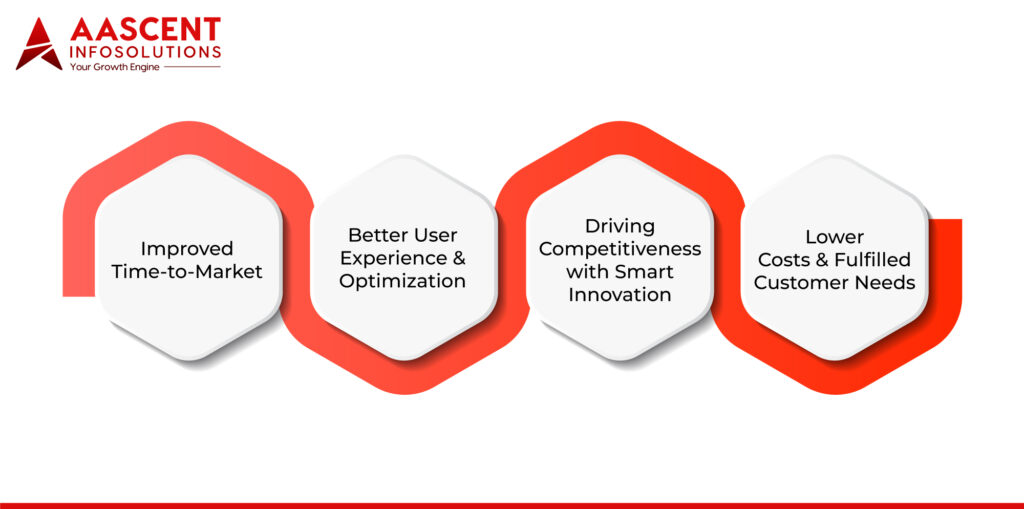
Improved Time-to-Market
Speed defines success in today’s digital-first economy. Companies that launch faster gain customer attention and stay ahead of competitors. Digital engineering services simplify the development process. It turns ideas into reliable, future-ready digital products. With an effective digital product engineering strategy, businesses respond faster while maintaining reliability.
Enhanced User Experience and Optimization
Experience defines loyalty. An effective digital product design makes every interaction simple and intuitive. Every touchpoint is optimized to meet customer needs and enhance engagement. Plus, experience-centric design boosts satisfaction and brand loyalty.
Digital product engineers now use cognitive technologies and data-driven intelligence to design smarter products. These systems learn from behaviour, personalize experiences, and improve performance.
Fueling Competitiveness Through Intelligent Products
Innovation is a growth driver. Digital product development combines AI and advanced analytics to deliver personalized services at scale. This creates products that adapt in real time and outperform traditional solutions.
For example, a leading UK retail bank faced challenges with legacy systems that limited data visibility. With an AIOps-powered solution in place, the bank was able to:
- Real-time anomaly detection.
- Transparency across infrastructure.
- Actionable insights for business and operations teams.
This solution enabled faster decisions, optimized performance, and improved customer experience across all channels.
Reduced Operational Costs and Meeting Customer Demands
Efficiency is as critical as innovation. A robust digital product engineering strategy enables businesses to cut costs. Meanwhile, resilient infrastructures provide the flexibility to adapt. By embracing AI-powered automation, enterprises anticipate customer behaviour. It helps them uncover their expectations and develop personalized applications.
Read also: Digital Engineering vs Quality Engineering: What’s the Difference?
Common Digital Product Engineering Challenges and Their Solutions
Building digital products isn’t without hurdles. Look at the challenges in digital product engineering and their practical solutions:
1. Outdated Legacy Systems
Off-the-shelf solutions often slow down processes and block agility. They also rely on outdated tools and technologies, which makes integration difficult.
Solution
Replace them with cloud-native platforms. With futuristic digital engineering services, they support intelligent ecosystems that are flexible and scalable.
2. Holistic Collaboration
Siloed teams cause delays and misaligned results. This leads to a lack of real-time communication between teams.
Solution
Foster an agile-driven transformation. Use modern tools and API-first ecosystems for connected teamwork and faster delivery.
3. Product Quality & Traceability
Manual workflows reduce transparency and lead to compliance-based issues. It also creates inefficiencies in tracking defects, which slows down releases.
Solution
Apply hyper-automation for resilient delivery. Plus, embed data-driven intelligence for full traceability.
4. Testing & Quality Assurance
Late-stage evaluation leads to rework and delays. Plus, it becomes hard to find the threats until the final phase.
Solution
Adopt shift-left testing, powered by cognitive technologies. It detects defects early and ensures reliability.
By addressing these Digital Product Engineering Challenges, companies build stronger foundations. It helps them deliver products faster, safer, and smarter.
Read also: Data Engineering vs Digital Engineering: Which One Matters to Your Business?
Build Future-Ready Digital Products with Aascent InfoSolutions for Maximum ROI
We provide end-to-end product engineering services designed for value-driven innovation and ROI-optimized delivery. From advisory to deployment, our solutions ensure business-aligned digital ecosystems that drive measurable impact.
Why Partner with Aascent InfoSolutions?
- Enterprise-grade solutions trusted across industries.
- Customer-first engineering with data-driven design.
- Faster launches through agile methods.
- Bring cloud, IoT, and AI together without disruption.
- Complete lifecycle support with transformation-ready frameworks.
Our Transformative Capabilities
- Strategic product roadmap.
- End-to-end management.
- Innovative product creation and performance-driven architectures.
- Next-gen software evolution for next-gen competitiveness.
- Continuous optimization backed by adaptive growth models.
Our digital product engineering services follow growth-centric strategies. It helps them unlock new revenue opportunities with concrete results. At every stage, we align technology with business outcomes. It ensures products remain market-responsive and innovation-led.
FAQs
1. What is Digital Product Engineering?
Digital Product Engineering is all about creating and managing digital solutions. It builds innovative digital products through modern-day technologies. These products grow with your business and support long-term goals.
2. Which advantages can a digital product strategy bring to a business?
An effective digital product strategy delivers tangible results across multiple dimensions of business growth. Here are the most impactful benefits:
- Faster Market Entry.
- Cost Efficiency.
- Better User Experience.
- Long-lasting Results.
- Stronger Competitive Edge.
3. What Is the Cost of Digital Product Engineering?
The cost of digital product engineering depends on a variety of factors. This includes complexity, tech stack, product scope, and required integrations. Startups often prefer to start with a lower budget. Enterprises, on the other hand, often invest more to achieve advanced customization.